

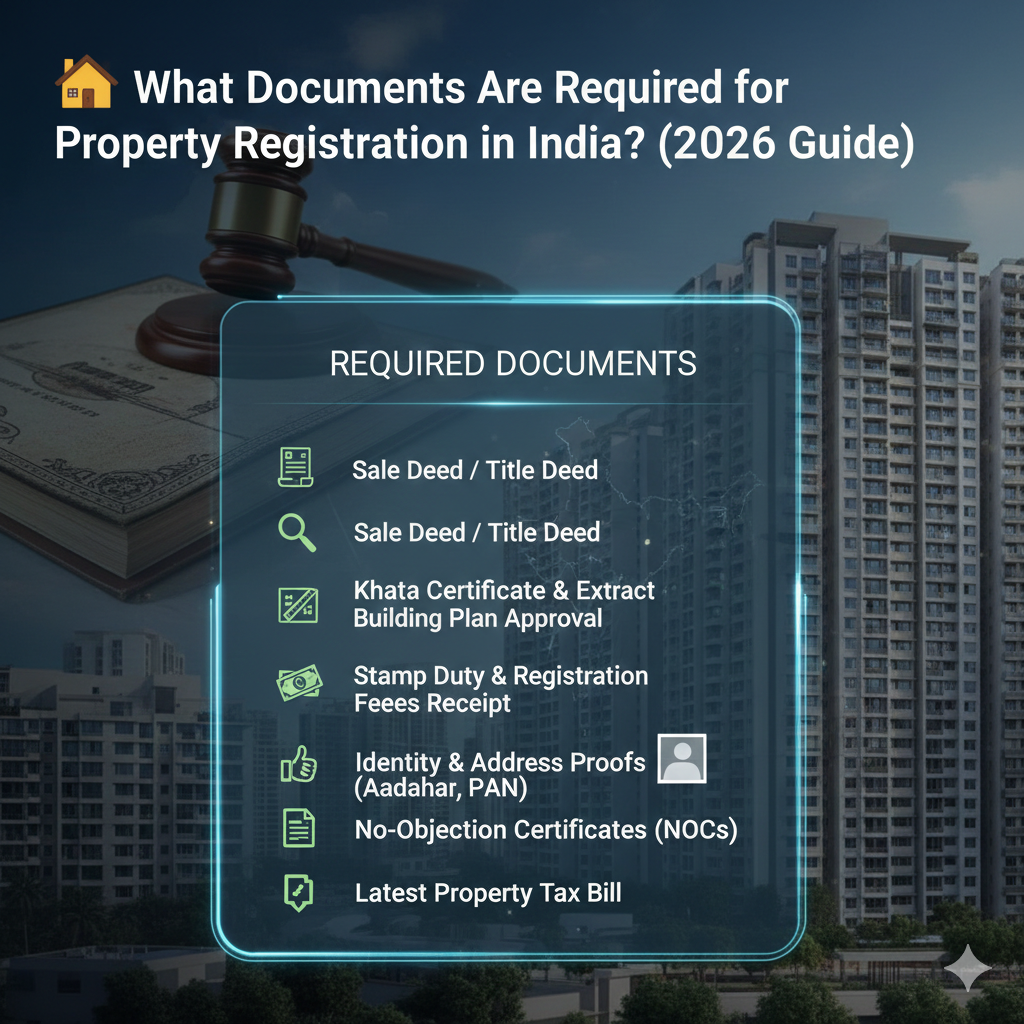
Buying a property in India involves legal formalities, and property registration is one of the most important steps. Registration legally proves that you are the rightful owner of the property. To ensure a smooth process, you must submit the correct set of documents.
Below is the complete checklist of documents required for property registration in India.
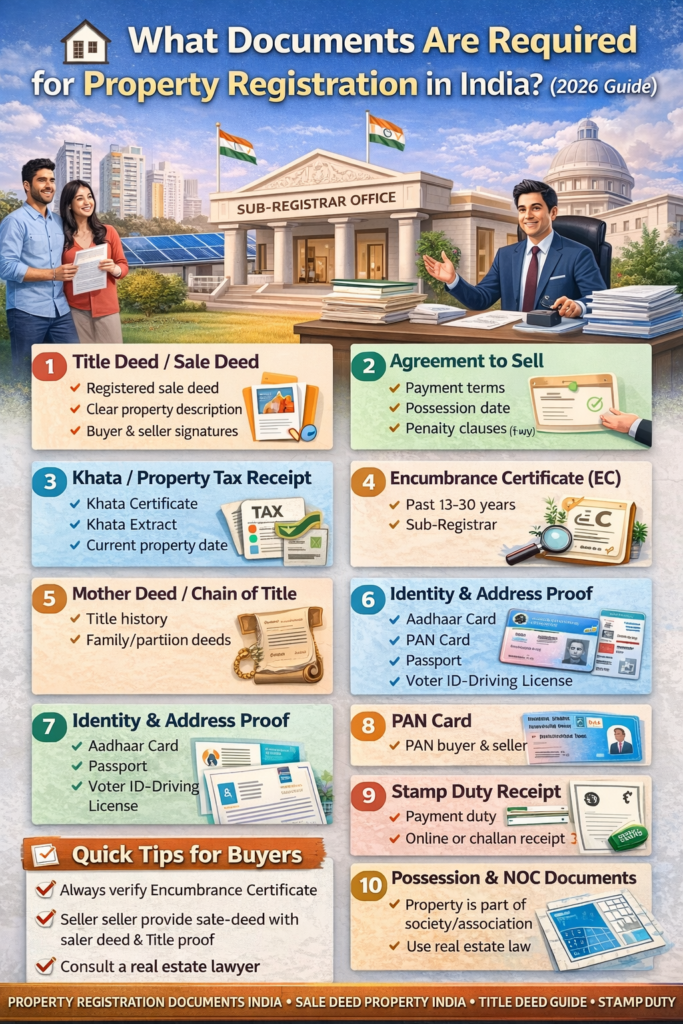
📌 1. Title Deed / Sale Deed
Purpose: Shows the transfer of ownership from the seller to the buyer.
✔ Registered sale deed
✔ Clear description of property
✔ Buyer and seller signatures
This is the most important document for registration.
📌 2. Agreement to Sell
Purpose: A preliminary contract between buyer and seller, usually signed before the final sale deed.
✔ Payment terms
✔ Possession date
✔ Penalty clauses (if any)
This helps during registration and tax calculation.
📌 3. Khata / Property Tax Receipt
Purpose: Confirms that the property is listed with the local municipal authority.
✔ Khata Certificate
✔ Khata Extract
✔ Up-to-date property tax receipt
These documents prove that the property is under the local civic body.
📌 4. Encumbrance Certificate (EC)
Purpose: Shows if the property has any legal liabilities, mortgages, or loans registered against it.
✔ Issued by Sub-Registrar Office
✔ Usually covers past 13–30 years
Buyers must always verify EC to avoid buying disputed property.
📌 5. Mother Deed / Chain of Title
Purpose: Shows historical ownership records of the property.
✔ Registered title documents from previous owners
✔ Family deeds, gift deeds, partition deeds (if applicable)
This ensures a clear title chain.
📌 6. Identity & Address Proof
Required for both buyer and seller.
✔ Aadhaar Card
✔ Passport
✔ Voter ID
✔ Driving License
At least one government-issued ID with an address must be submitted.
📌 7. PAN Card
Purpose: Used for calculating property tax and TDS (if applicable).
✔ PAN of buyer and seller
✔ If NRI is involved, Form 60/61 may be provided
PAN is necessary for all financial and tax purposes.
📌 8. Stamp Duty Receipt
Purpose: Proof that stamp duty has been paid on the sale deed.
✔ State stamp duty payment
✔ Online or challan receipt
Stamp duty varies by state and must be paid before or at registration.
📌 9. Possession & NOC Documents
Purpose: Confirms that the property is free from attachments and ready for transfer.
✔ Possession letter
✔ No Objection Certificate (if property is part of society/association)
Required especially for apartments and gated communities.
📌 10. Power of Attorney (If Applicable)
If the buyer or seller cannot be present:
✔ Registered Power of Attorney (POA)
✔ POA Holder’s ID & address proof
Note: Some states restrict property transactions via POA, so verify local rules.
📌 11. Property Plan & Layout
For plots and new developments:
✔ Site plan approved by the local authority
✔ Building plan (if constructed)
Required to confirm the property matches registered entries.
🧾 Bonus: Additional Documents (If Needed)
Depending on the property type and location:
- NOC from society/association
- Conversion Certificate (agricultural land)
- Allotment letter (in case of plots or flats)
- Completion certificate (for constructed buildings)
🛠 Property Registration Procedure (Quick Steps)
- Prepare documents & drafts
- Pay stamp duty
- Visit the Sub-Registrar Office
- Sign the sale deed in the presence of witnesses
- Registration & submission of documents
- Receive the registered deed
After this, your property is legally recorded in your name.