

📊 Overview: Maharashtra’s Leading Property Markets
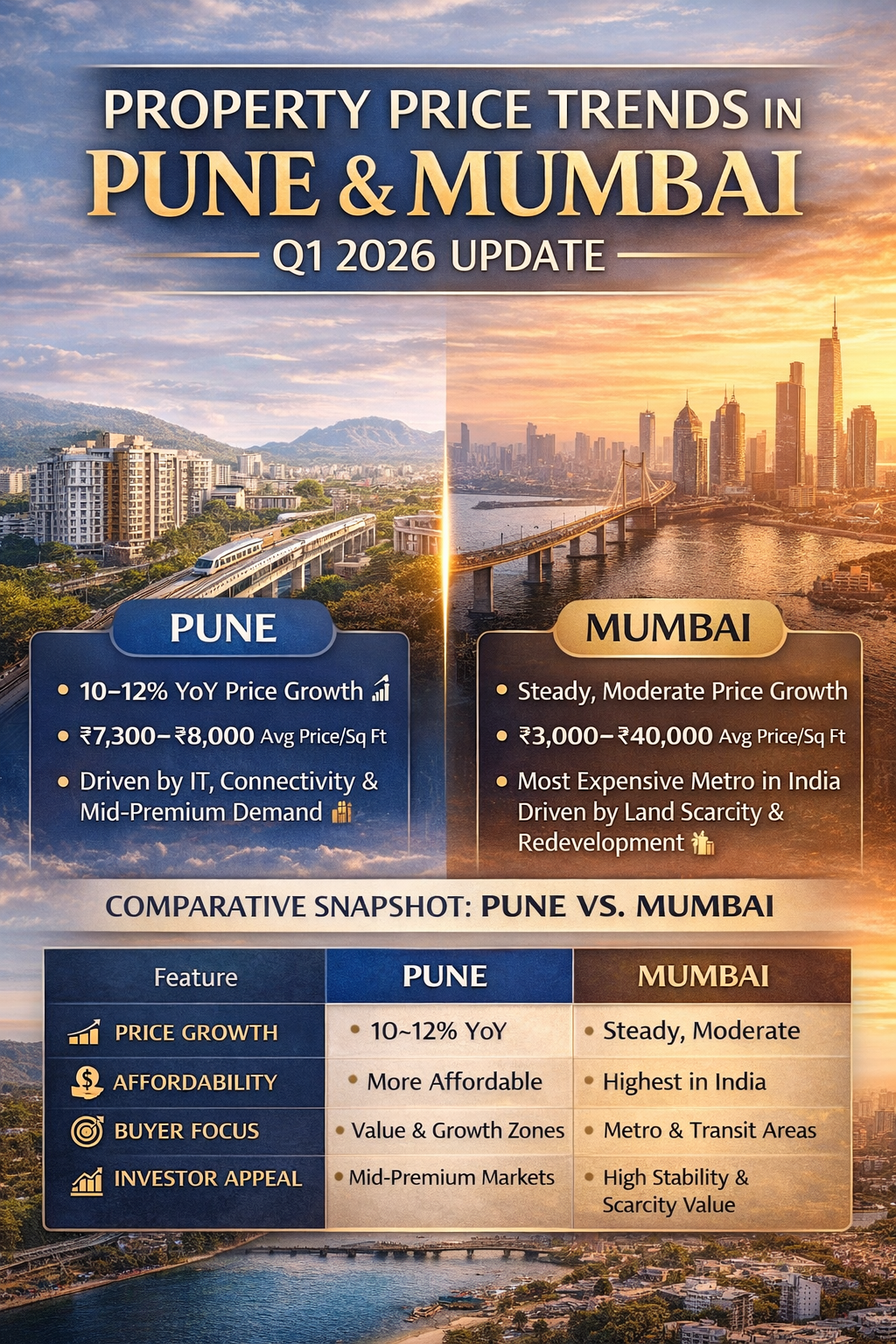
Both Pune and Mumbai have remained key hubs in India’s residential real estate landscape. While Pune continues its trajectory as a high-growth and relatively affordable market, Mumbai sustains its position as the country’s most expensive property ecosystem, each with distinct pricing patterns, demand drivers, and investor sentiment.
🏡 Pune: Sustained Growth with Selective Price Moderation
📈 Steady Price Appreciation
Pune’s property prices have continued their upward trend heading into Q1 2026:
- Average residential rates across the city are now estimated at around ₹7,300–₹8,000 per sq ft, representing an approximate 10–12% YoY increase in many prime micro-markets.
🏙️ Shift in Buyer Preferences
The market is shifting from rapid speculative growth to value-oriented purchases:
- Buyers are increasingly focused on quality and connectivity (metro proximity, job hubs) rather than speculative buying.
🔁 Affordability and Segment Dynamics
- Mid-range homes in the ₹50 lakh – ₹1 cr segment dominate demand, with thriving interest in larger 2–3 BHK units.
- Smaller, sub-₹50 lakh housing stock is shrinking as developers focus more on mid-to-premium projects — reflecting rising construction and input costs.
📍 Location-Specific Trends
- Established hubs like Baner, Wakad, and Kharadi continue to see premium pricing due to strong employment-led demand.
- Emerging corridors (e.g., Punawale, Mahalunge) are gaining traction as more affordable growth zones.
Takeaway: Pune’s 2026 pricing reflects healthy long-term appreciation, with moderate growth rates driven by employment growth, infrastructure development, and evolving buyer behaviour.
🏙️ Mumbai: Price Stability with Structural Strength
📈 Citywide Price Trends
Mumbai remains India’s priciest real estate market:
- Residential prices vary widely, from ₹3,000+ per sq ft in outer fringe areas to ₹40,000+ per sq ft in prime central regions, based on recent market data.
- Some suburbs like Thane have recorded strong long-term growth (up to ~46% over three years) due to demand and affordability relative to core Mumbai.
🏘️ Pressure on Affordability
- Price hikes and supply constraints have made central suburbs extremely costly, prompting buyers to explore:
- Suburban micro-markets
- Emerging nodes in Navi Mumbai
- Locations with better connectivity and space.
📊 Market Structure and Buyer Response
- Mumbai’s market shows more stable price growth rather than sharp spikes — supported by limited land availability and redevelopment dynamics.
- Developers are increasingly offering pricing incentives (e.g., waiving floor-rise premiums) and flexible payment plans to attract buyers amid rising inventory.
📍 Influence of Infrastructure and Redevelopment
Connectivity projects and major infrastructure — such as metro expansions and the Mumbai Trans Harbour Link — continue to influence pricing patterns across MMR, often underpinning selective price uplifts in metro-linked corridors.
Takeaway: While Mumbai prices remain elevated, the trajectory into Q1 2026 is one of moderate but steady growth, with pockets of strong performance driven by infrastructure and redevelopment, and buyer preference shifting toward transit-oriented and suburban locations.
📌 Comparative Snapshot: Pune vs. Mumbai (Q1 2026)
| Feature | Pune | Mumbai |
|---|---|---|
| Price Growth | ~10–12% YoY in key pockets | Steady, moderate rise in most corridors |
| Affordability | More affordable compared to Mumbai | Land scarcity, redevelopment, and infrastructure connectivity |
| Market Drivers | IT jobs, metro expansion, mid-premium segments | Land scarcity, redevelopment, infrastructure connectivity |
| Buyer Focus | Value & connectivity | Metro & suburban options |
| Investor Appeal | Rising long-term value | High price stability & scarcity value |
📈 Key Drivers Behind Trends
📍 Infrastructure Impact
Continued improvements like Pune’s metro extension and Mumbai’s metro and road networks are shifting demand to better-connected locations, often resulting in price premiums for accessible micro-markets.
💰 Financing & Interest Dynamics
Any policy or rate changes (e.g., repo rate cuts) can significantly affect buyer sentiment and affordability, indirectly influencing price movements as borrowing costs change.
📉 Buyer Behaviour
As buyers become more selective and value-driven (especially in Pune), pricing growth is becoming more structure-oriented rather than speculative.
🏁 Final Thoughts – Early 2026 Outlook
For property buyers and investors in Q1 2026:
- Pune offers strong value appreciation and robust demand in mid-to-premium segments.
- Mumbai commands high pricing due to land scarcity and demand stability, with emerging suburban and transit-linked corridors offering more accessible entry points.
Both cities remain core components of Maharashtra’s real estate story, each with distinct price behaviors, buyer profiles, and investment opportunities.